A personal loan is money you borrow without pledging anything, and you repay it in fixed monthly instalments over an agreed period. That's the whole idea.
The details decide whether a particular loan suits you: who's lending, how the rate is set, what it costs beyond the rate, and what protections apply. This guide covers each of them and links to a fuller explanation where you need one.
What is a personal loan?
Three features set a personal loan apart from other borrowing.
 It's unsecured. You don't pledge property, gold or deposits. The lender decides mainly on your credit history and income, which is why rates are higher than on secured loans such as home or gold loans.
- It's usually fixed-rate. The rate is set when you take the loan and stays the same, so your EMI stays the same too.
- You can use it for anything. A wedding, medical bills, a phone, home repairs, a course fee, travel, or clearing a more expensive debt. Lenders assess whether you can repay, not what you're buying.
Who lends, and how do apps fit in?
Personal loans in India come from regulated entities: banks and NBFCs registered with the RBI. Only they can lend.
Many loan apps are not lenders. They are Lending Service Providers (LSPs) that run the application, verification, and servicing on behalf of one or more regulated lenders. The app you use is called a Digital Lending App (DLA).
This is a regulated model, and it's how Prefr works. Prefr connects applicants with RBI-registered lending partners: Aditya Birla Capital, Poonawalla Fincorp, SMFG India Credit, MAS Financial Services, Si Creva Capital Services and Respo Financial Capital. This means the app you use and the lender you owe are different organisations, so you should always know which lender holds your loan.
Our guide on comparing personal loan apps covers what to check between platforms.
The terms you'll see on every offer
| Term | What it means |
|---|---|
| Loan amount | The sum sanctioned by the lender |
| Interest rate | The annual rate charged on the outstanding balance |
| Processing fee | A one-time charge, plus GST, deducted before disbursal |
| Disbursed amount | What reaches your account after the fee is deducted |
| APR | The annual cost including interest and fees; the figure to compare offers on |
| EMI | The fixed monthly payment covering principal and interest |
| Tenure | The repayment period in months |
| Foreclosure charge | The fee, if any, for closing the loan early |
| Key Fact Statement (KFS) | The standard summary of all of the above, given before you accept |
The gap between interest rate and APR catches most people out. On a ₹5 lakh, 18-month loan at 18% with a ₹15,000 processing fee plus GST, the APR is 25.4%. The difference is the fee, spread across the tenure.
Personal loan interest rates
Personal loan rates are priced on the borrower. Two people applying on the same day through the same platform can be offered different rates.
Through Prefr's lending partners, rates range from 18% to 30% per annum. Where you fall depends mainly on:
- Credit score, usually the biggest single factor
- Income level and stability
- Existing EMIs as a share of your income
- Employer or business profile
- Repayment history across all your credit accounts
Personal loans from regulated lenders are usually calculated on a reducing balance, so interest is charged only on what you still owe. A flat rate charges interest on the original amount throughout and costs considerably more at the same headline rate.
For what moves your rate and how to lower it, see our guide to personal loan interest rates and eligibility.
What are the personal loan eligibility criteria?
For Prefr, the baseline is:
| Criteria | Requirement |
|---|---|
| Age | 21 to 55 years |
| Net monthly income | ₹15,000 or more |
| Credit score | 650 or above |
| Employment | Salaried or self-employed |
Also Read: Personal Loan Eligibility in India: Full Checklist
Meeting these makes you eligible to apply. The lending partner makes the final decision on your full profile. Most lenders also want your total EMIs, including the new loan, to stay within about 50% to 60% of net monthly income.
Checking eligibility is a soft enquiry and doesn't affect your credit score. A formal application is a hard enquiry and does affect your credit score. So check first, then apply once. You can check your credit score on Prefr before you start.
Profile factors also decide how quickly you're approved. Our guide on what affects loan approval speed covers them.
Steps for personal loan application
An online personal loan application usually follows six steps:
- Eligibility check: a soft enquiry using your PAN, date of birth and income
- Application details: entered exactly as they appear on your documents
- KYC: through Aadhaar OTP or video KYC
- Offer and Key Fact Statement: reviewed before you accept
- E-mandate: to set up automatic EMI payments through net banking or a debit card
- eSign and disbursal
With Prefr, approval is instant and disbursal typically completes within 30 minutes. It can take up to 24 hours depending on your lending partner.For the documents you need and where applications usually stall, see our step-by-step application guide.
EMIs and repayment
Your EMI stays the same each month, but the split changes over time. Early EMIs are mostly interest and later ones mostly principal. That's why prepaying early saves much more than prepaying near the end.
Tenure is the main decision. A longer tenure lowers the EMI and raises the total interest. A shorter one does the opposite. The Prefr EMI calculator shows both as you move the sliders.
To understand how EMIs work, read what EMI is. To plan one before applying, see our guide on calculating your personal loan EMI.
The rules that protect you in 2026
The RBI (Digital Lending) Directions, 2025 bring the earlier digital lending guidelines together into one framework. What they mean for borrowers:
- You'll know who your lender is. The app must name the regulated bank or NBFC funding your loan before you accept.
- You'll get a Key Fact Statement. It sets out the APR, all charges and the repayment schedule in a standard format before you sign.
- Multi-lender platforms must show the matching offers. An LSP working with several lenders has to display every offer that matches your request, each with the lender's name, amount, tenure and APR, so you can compare them side by side.
- You can change your mind. A cooling-off period after disbursal lets you exit the loan by repaying the principal and proportionate APR without a foreclosure penalty. The period is stated in your KFS.
- The app can't charge you its own fees. Anything owed to the LSP is paid by the lender, not added to your costs.
- You can check whether an app is registered. Regulated lenders must report their lending apps to the RBI, which publishes a directory.
- There's a route for complaints. Every lender and LSP must name a grievance redressal officer. If a complaint isn't resolved within 30 days, you can escalate it to the RBI Ombudsman.
When a personal loan is the right choice
A personal loan works best for a meaningful amount you'll repay over several months, when you'd rather not pledge an asset. For a small amount you can clear within a month, paying off a credit card in full usually costs less. If you have gold and want a lower rate, a gold loan may cost less, but it comes with the risk of the gold.
Before you apply, borrow only what you need, not the maximum on offer. Choose a tenure whose EMI you could still pay in a difficult month. And be wary of any offer that asks for money upfront, doesn't name its lender, or pushes you to decide within minutes. Our guide on borrowing responsibly when you need money quickly goes into this in more detail.
Personal loans through Prefr
Prefr offers loans up to ₹5 lakh through its RBI-registered lending partners, with tenures from 6 to 60 months and interest rates from 18% to 30% per annum, subject to your profile. The process is fully digital, with no physical paperwork. Approval is instant, and disbursal typically completes within 30 minutes, though it may take up to 24 hours depending on your lending partner.
For questions, write to wecare@prefr.com or call 040-6988 1555. For complaints, Prefr's grievance officer can be reached at nodal.officer@prefr.com or 040-6988 2777.
Frequently Asked Questions
How does a personal loan work in India?
What is the current personal loan interest rate?
What is the eligibility for a personal loan?
What documents are needed for a personal loan application?
Is a loan app the same as a lender?
What is a Key Fact Statement?
Can I cancel a personal loan after it's disbursed?
How do I complain about a lender or loan app?
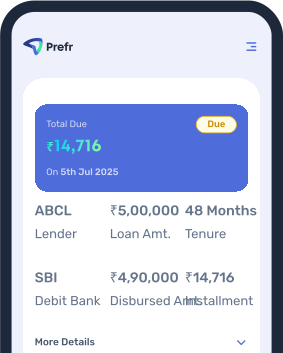
Already have a loan?
Check your loan details, track your EMI and many more