How to Compare Personal Loan Apps: Find the Easiest and Fastest Instant Personal Loan Options

Open the Play Store, search "instant personal loan", and you'll get a few hundred results. Most of the listings say the same four things. Instant approval. Minimal documents. Money in minutes. Low interest rates.
They can't all be right, and the word doing the most work in those listings is "instant", which, depending on the app, might describe approval, or disbursal, or just how fast the app tells you it has received your application.
So the useful question isn't which personal loan app is fastest. It's what each app actually measures when it says fast, and whether the loan underneath is any good once speed stops mattering.
First, understand what "instant" is describing
Three separate things happen between opening an instant money loan app and having money in your account. Apps often blur them into one number:
 Eligibility check: The app pulls your credit score and income details and tells you whether you're likely to qualify, and for roughly how much. This can genuinely take under a minute because it's a soft check against basic criteria.
- Approval: A lender reviews your application and commits to an amount, a rate and a tenure. This is where underwriting happens. Some lenders automate it fully, which is what makes instant approval possible.
- Disbursal: The money moves to your bank account. This depends on the lender's payment cycle, your bank, and whether your KYC and mandate registration have cleared.
An app can be honest about all three and still take four hours to get you money. Another can advertise "loan in 5 minutes" and mean the eligibility check. When you're comparing, ask which stage the number refers to. If the app doesn't say, treat it as the eligibility check.
What to compare, in order of how much it costs you?
Speed matters when you need money on a Tuesday for something that can't wait until Friday. After that week is over, you're left with the rate, the fee and the tenure for the next year or two. Compare in that order of impact.
| What to check | Why it matters | Where to find it |
|---|---|---|
| APR, not just interest rate | APR includes the processing fee and charges, so it's the only figure that compares two loans fairly | Key Fact Statement, before you accept |
| Processing fee + GST | Deducted upfront, so you receive less than the sanctioned amount | KFS and loan agreement |
| Tenure range | A longer tenure lowers the EMI and raises total interest paid | App's product page or FAQ |
| Foreclosure charges | Decides whether early repayment actually saves you money | Loan agreement, fee schedule |
Two loans can both quote 18% and cost very differently. One charges a 1% processing fee, the other charges 3%. On ₹5 lakh, that's a ₹10,000 gap before you've paid a single EMI. The APR is what catches this, which is why RBI requires lenders to state it.
Important: Check who the actual lender is
Many loan apps are not lenders. They're Lending Service Providers, or the digital front-end for one or more NBFCs and banks. That's a legitimate and regulated model; Prefr operates this way, but it means the app you're using and the entity you owe money to are different organisations.
Under RBI's Digital Lending Guidelines, an app has to tell you upfront which regulated lender your loan is coming from. You should be able to find:
- The name of the RBI-registered bank or NBFC funding your loan, before you accept the offer
- A Key Fact Statement showing the APR, all charges and the recovery mechanism
- A cooling-off period during which you can exit the loan by repaying the principal and proportionate APR
- A named grievance redressal officer with contact details
If an app won't name its lender until after you've submitted documents, that's a reason to close it. Unregistered lending apps have been removed from Indian app stores repeatedly, and the borrower is the one left dealing with the fallout.
What the "top 10 instant loan apps in India" lists won't tell you?
Search for a ranked list on instant personal loans, and you'll find plenty. Most are affiliate pages where placement correlates with commission rather than loan quality, and almost none of them can rank apps on the thing that varies most: what rate you specifically get.
Interest rates on personal loans are risk-priced. Two people using the same app with the same loan amount can be quoted rates several percentage points apart, based on credit score, income stability and existing obligations. An app that's cheapest for someone with an 800 score and a salary account may not be cheapest for you.
The practical alternative is to check your eligibility on two or three apps before committing. Eligibility checks are soft enquiries and don't affect your credit score. The formal application is a hard enquiry, so apply once you've decided.
Red flags worth taking seriously
- Upfront payment requests: No legitimate lender asks for a fee before disbursal. Fees are deducted from the loan amount.
- Pressure on the timer: "Offer expires in 10 minutes" on a loan is a sales tactic, not a lending constraint.
- Broad permission requests: An app asking for contacts, gallery or SMS access beyond one-time KYC needs has no lending reason to want them. DLG rules restrict this.
- No written agreement: You should receive the loan agreement and KFS on record, in a language you can read.
- A rate quoted without an APR: If they won't give you the all-in number, assume there's a reason.
Where does Prefr fit?
Prefr is an instant loan provider app that connects you with RBI-registered lending partners, including Aditya Birla Capital, Poonawalla Fincorp, SMFG India Credit, MAS Financial Services, Si Creva Capital Services and Respo Financial Capital. Loans go up to ₹5 lakh, with tenures from 6 to 60 months, subject to your eligibility and your lending partner's assessment.
On speed, specifically: approval is instant. Disbursal typically happens within 30 minutes, though it can take up to 24 hours depending on which lending partner your loan is with. Interest rates range from 18% to 30% per annum, and the rate you're offered depends on your profile.
Eligibility is straightforward. You need to be between 21 and 55, earning at least ₹15,000 a month, with a credit score of 650 or above. The process is fully digital, so no physical paperwork.
An illustrative repayment example
| Component | Amount |
|---|---|
| Loan amount | ₹5,00,000 |
| Interest rate | 18% per annum |
| Tenure | 18 months |
| Processing fee + GST | ₹15,000 + ₹2,700 |
| Amount disbursed | ₹4,82,300 |
| Monthly EMI | ₹31,903 |
| Total repaid | ₹5,74,254 |
| APR | 25.4% |
Note the gap between the 18% interest rate and the 25.4% APR. That's the processing fee, annualised. It's the same gap you'll find with any lender charging an upfront fee, and it's the reason APR is the number to compare on.
Your actual figures will differ based on the amount, tenure and rate you're approved for.
Checklist to check before hitting the apply button
Run through this checklist once to see if you know all the facts about the loan before applying:
- Do you know the name of the entity actually lending you the money?
- Have you seen the APR, not just the interest rate?
- Do you know what the EMI is and whether your monthly budget absorbs it?
- Do you know the foreclosure charges if you want to close early?
- Is there a grievance officer you can reach if something goes wrong?
If you can answer all five, you're comparing properly.
Frequently Asked Questions
Does checking eligibility on multiple loan apps hurt my credit score?
What credit score do I need for an instant personal loan?
What's the difference between interest rate and APR?
Can I get an instant personal loan if I'm self-employed?
Is it safe to use a personal loan app?
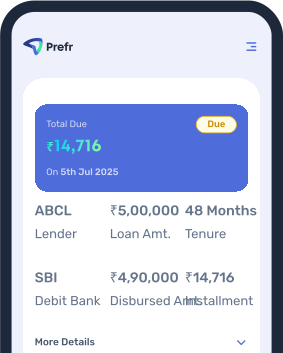
Already have a loan?
Check your loan details, track your EMI and many more