CIBIL Score for Personal Loan: Free Check & Minimum Score

Before a lender approves your personal loan, they look at one number first: your CIBIL score. It is the fastest way for a bank or NBFC to judge how likely you are to repay on time. If you are planning to apply for a personal loan, doing a CIBIL score check before you submit your application can save you from a rejection or a high interest rate.
This guide explains what CIBIL score you need for a personal loan, how the score influences your interest rate, and how to check it online for free in a few minutes.
What Is a CIBIL Score and Why Lenders Check It
Your CIBIL score is a three digit number between 300 and 900, calculated by TransUnion CIBIL based on your credit history. It reflects how you have handled credit cards, loans, and EMIs in the past.
Lenders use this score to answer a simple question: if they lend you money, will you pay it back on time? A higher score signals lower risk, which is why it directly affects whether your personal loan gets approved and at what interest rate.
Your score is built from factors like:
 Repayment history on existing loans and credit cards
- Credit utilization (how much of your available credit you are using)
- Length of your credit history
- Number of new credit applications in a short span
- Mix of secured and unsecured credit
Minimum CIBIL Score Needed for a Personal Loan
Most banks and NBFCs in India look for a CIBIL score of at least 700 to approve a personal loan, though the exact cutoff varies by lender. Here is a general breakdown of what different score ranges typically mean for your application:
| CIBIL Score | What It Means for You |
|---|---|
| 750 and above | Strong approval chances, best interest rates, higher loan eligibility |
| 700 to 749 | Good approval chances, standard interest rates |
| 650 to 699 | Approval possible but with higher interest rates or lower loan amount |
| Below 650 | Approval difficult with most lenders, may need a co-applicant or collateral |
If your score falls below 650, some lenders may still consider your application by looking at other factors such as your income, employment stability, and existing relationship with the bank, but you should expect a higher interest rate or a lower approved amount.
How Your CIBIL Score Affects Your Interest Rate
A better CIBIL score does not just improve your approval odds, it also lowers what you pay. Lenders price personal loans on a risk basis, so a score of 750+ can get you a noticeably lower interest rate than a score of 680, even for the same loan amount and tenure.
Over a two or three year loan tenure, this difference in interest rate can add up to a meaningful amount in extra EMI outflow. This is one of the most practical reasons to check and improve your score before you apply, rather than after a lender quotes you a rate.
How to Check Your CIBIL Score Online for Free
You are entitled to one free CIBIL score and credit report every calendar year, as per RBI guidelines. Here is how to check it:
Step 1
Visit an Authorized Platform
You can check directly on the official CIBIL website, or through RBI-regulated banks, NBFCs, and fintech platforms that offer free score checks.
Step 2
Enter Your PAN and Basic Details
Your CIBIL score is linked to your PAN card, so you will need to provide it along with your name, date of birth, and contact details.
Step 3
Verify Your Identity
Most platforms send an OTP to your registered mobile number for verification.
Step 4
View Your Score and Report
Once verified, you can see your score along with a summary of your credit accounts, repayment history, and any errors that might be affecting your score.
Checking your own CIBIL score is called a "soft inquiry" and does not impact your score in any way. You can check it as often as you like without any negative effect on your creditworthiness.
How to Improve a Low CIBIL Score Before You Apply
If your score is lower than you would like, a few months of consistent habits can move the needle before you apply for a personal loan:
- Pay EMIs and credit card bills on time: Payment history has the biggest impact on your score, so even one missed payment can pull it down.
- Keep credit card utilization low: Try to use less than 30 percent of your total credit limit at any time.
- Avoid applying for multiple loans or cards in a short period: Each application triggers a hard inquiry, and too many in a short window can lower your score.
- Check your credit report for errors: Incorrect entries, such as a loan that was actually closed but still shows as active, can drag your score down unfairly. Raise a dispute with the bureau if you spot one.
- Do not close old credit accounts unnecessarily: A longer credit history generally works in your favor.
Other Factors Lenders Check Besides Your CIBIL Score
Your CIBIL score gets you in the door, but it is rarely the only thing a lender evaluates. Once your score clears the minimum bar, lenders typically look at:
- Income stability: A steady salary or consistent business income reassures a lender that you can absorb a new EMI without strain, even if your score is only decent rather than excellent.
- Existing debt obligations: Lenders calculate your Fixed Obligation to Income Ratio (FOIR), which measures how much of your monthly income already goes toward EMIs and other fixed payments. A high FOIR can hurt your application even with a strong CIBIL score.
- Employment type and tenure: Salaried applicants with a longer tenure at their current employer, or self-employed applicants with an established business, are generally viewed as lower risk.
- Age and repayment capacity: Your age affects the maximum tenure a lender will offer, since most lenders want the loan to close well before retirement age.
- Relationship with the lender: If you already bank with a lender or have repaid a previous loan with them, this existing relationship can sometimes work in your favor during approval.
This is why two applicants with the same CIBIL score can get different loan offers. Your score sets the starting point, but the rest of your profile shapes the final terms.
What to Do If Your CIBIL Score Check Shows an Error
Sometimes a lower than expected score is not really about your repayment behavior, it is a data error. This happens more often than people expect, especially with joint accounts, closed loans still showing as active, or a payment that was made on time but reported late.
If you spot something incorrect on your report:
- Note the exact discrepancy: Compare the entry against your own records, such as bank statements or loan closure letters.
- Raise a dispute with CIBIL or the platform you checked through: Most platforms have a formal dispute resolution process for this.
- Follow up with the lender that reported the error: Since lenders report data to CIBIL, they usually need to confirm and correct it before your score updates.
- Allow time for the correction to reflect: Updates typically take a few weeks to show up in your score after a dispute is resolved.
Catching and correcting an error before you apply for a personal loan can meaningfully improve your approval odds and the interest rate you are offered.
Frequently Asked Questions
What is a good CIBIL score for a personal loan?
A score of 750 or above is generally considered good and gives you the best chance of approval at a competitive interest rate. Scores between 700 and 749 are still workable with most lenders.
Can I get a personal loan with a CIBIL score below 700?
Does checking my own CIBIL score lower it?
How often is my CIBIL score updated?
Is CIBIL score check free for personal loan applicants?
The Bottom Line
Your CIBIL score is one of the biggest levers you control before applying for a personal loan. Check it early, fix any errors, and give yourself a few months to improve it if needed. It could mean the difference between a rejected application and a loan approved at a rate that actually works for you.
Rates, eligibility criteria, and approval decisions vary by lender and change over time, so confirm current terms before you apply.
Check Your CIBIL Score and Apply for a Personal Loan with Prefr
Already have a loan?
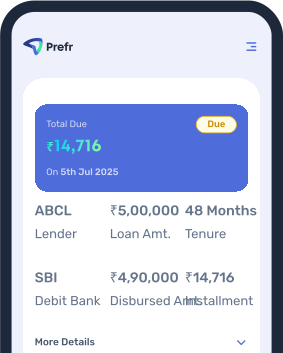
Check your loan details, track your EMI and many more