7 Things to Check Before Accepting a Personal Loan Offer (Most Borrowers Miss #4)

Getting a personal loan approved feels like a win. But accepting the first offer that comes your way without reading the fine print, which can cost you significantly more than you expected.
The gap between the headline rate and what you actually pay is where most borrowers get caught. A thorough comparison before you sign takes 15 minutes and can save thousands of rupees over the loan tenure.
Here are the seven things to check before you accept any personal loan offer.
1. The Interest Rate: Flat Rate or Reducing Balance?
The interest rate advertised is not always the rate you pay on the outstanding balance.
 Reducing balance rate (most common): Interest is charged on the remaining principal each month. As you repay, your interest component decreases. This is the standard method used by most banks and NBFCs.
- Flat rate: Interest is calculated on the entire original loan amount for the full tenure, even though your outstanding principal reduces each month. Flat rate loans are significantly more expensive than they appear.
Example: A 12% flat rate on a ₹2,00,000 loan over 24 months works out to an effective reducing balance rate of approximately 21–22%.
Always ask: Is this rate on a reducing balance or flat basis? If the lender advertises a flat rate, ask for the equivalent APR (Annual Percentage Rate) before comparing.
2. The Annual Percentage Rate (APR), Not Just the Interest Rate
The APR includes the interest rate plus all fees and charges (processing fee, insurance premium, documentation charges), expressed as an annualised cost of borrowing.
It is the single most accurate number to compare between lenders.
Example:
- Lender A: 12% interest rate + 3% processing fee
- Lender B: 14% interest rate + 0% processing fee
Lender A may actually cost more despite the lower headline rate, depending on tenure and loan amount.
Always ask for the APR or the total cost of borrowing (principal + all interest + all fees) before comparing offers.
3. Processing Fee and Other Upfront Charges
Processing fees are deducted from your loan amount at disbursement, meaning you receive less than you applied for.
What to check:
- Processing fee percentage (typically 1–3% of the loan amount)
- Whether GST is charged on top of the processing fee (18% GST applies)
- Documentation charges, verification fees, or any other upfront deductions
Example: You apply for ₹2,00,000 at a 2% processing fee + 18% GST.
- Processing fee: ₹4,000
- GST on processing fee: ₹720
- Amount actually credited to your account: ₹1,95,280, but you pay EMI on ₹2,00,000.
Know your net disbursement before accepting.
4. Prepayment and Foreclosure Charges (Most Borrowers Miss This)
This is the one most people overlook, and it is the most expensive surprise if you plan to repay your loan early.
Most lenders charge a foreclosure fee (prepaying the entire outstanding amount) and a part-prepayment fee (paying extra towards principal in chunks).
Typical charges:
- Lock-in period: 6–12 months during which prepayment is not allowed at all
- Foreclosure charge: 2–5% of the outstanding principal after the lock-in period
- Part-prepayment charge: 1–3% on the prepaid amount
Why this matters: If you expect a bonus, inheritance, or income spike that lets you close the loan early, a high foreclosure charge can wipe out the interest savings.
What to ask: What is the lock-in period? What is the foreclosure charge after it? Is part-prepayment allowed, and at what charge?
5. EMI Amount and Its Impact on Your Monthly Budget
The EMI must be sustainable for the full tenure, not just the first few months.
Check:
- Total EMI across all your existing loans + this new loan combined
- Whether this keeps your EMI-to-income ratio below 40–50%
- Whether you have a 2–3 month emergency buffer in savings if your income dips temporarily
Common mistake: People calculate the EMI on the new loan only, forgetting to add their existing credit card minimums, car loan, or other personal loan EMIs.
Use an EMI calculator to see the exact monthly outflow before accepting. Try different tenure options. Extending the tenure by 12 months can reduce EMI by 15–20%, giving you more breathing room.
6. Penalty for Delayed or Missed EMI Payments
Life happens. Before you commit, know the cost of a missed payment.
What to check:
- Late payment fee (usually ₹500–₹1,500 per missed EMI)
- Penal interest rate on overdue amounts (typically 2–3% per month on overdue EMI)
- Whether missed payments are reported to CIBIL, and how quickly
A single missed EMI reported to CIBIL can drop your score by 50–100 points and affect your ability to borrow for the next 12–24 months.
Tip: Set up auto-debit (NACH mandate) for your EMI immediately after approval. It eliminates the risk of forgetting a payment date.
7. Loan Disbursal Timeline
When you need funds urgently, the disbursement timeline matters as much as the loan terms.
What to check:
- How long from approval to disbursement? (24 hours vs 3–7 working days)
- Is the process fully digital, or does it require physical document submission or branch visits?
- Are there additional verification steps that could slow things down?
For urgent needs (a medical emergency, a home repair that cannot wait), a 48-hour digital disbursal is worth significantly more than a marginally lower interest rate that takes 2 weeks to process.
A Quick Pre-Acceptance Checklist
Before you sign or click accept on any personal loan offer, run through this:
- Confirmed interest rate type (reducing balance, not flat)?
- Compared APR across at least 2–3 lenders?
- Noted the net disbursement amount after all fees?
- Checked foreclosure and part-prepayment charges?
- Calculated total EMI burden across all loans?
- Understood the missed payment penalty?
- Confirmed the disbursement timeline?
If you can answer yes to all seven, you are making an informed decision, not just accepting the first approval that arrived.
What Prefr Offers
Prefr is designed to be transparent across all of these points:
- Interest rate: Reducing balance method
- Loan amount: ₹51,000 to ₹5,00,000
- Tenure: 12 to 48 months, choose what works for your budget
- Process: 100% digital: apply, verify, and receive funds without visiting a branch
- No collateral: Unsecured personal loan for both salaried and self-employed applicants
- Fast disbursal: Funds credited quickly after approval
Frequently Asked Questions
What is the difference between a flat interest rate and a reducing balance rate?
Can I negotiate the interest rate or processing fee?
What happens if I miss an EMI?
Is it better to choose the shortest tenure possible to save on interest?
Can I transfer my personal loan to a different lender for a better rate?
The Bottom Line
A personal loan offer is not a yes-or-no decision. It is a financial contract you will live with for 1–4 years. Spending 15 minutes on these seven checks before accepting can save you anywhere from a few thousand to tens of thousands of rupees.
Read the sanction letter carefully. Ask questions. Compare at least two options. Then decide.
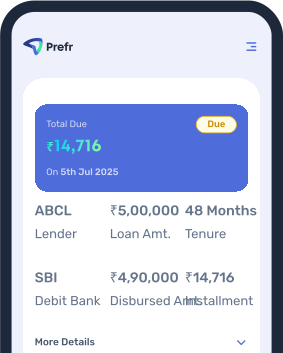
Already have a loan?
Check your loan details, track your EMI and many more